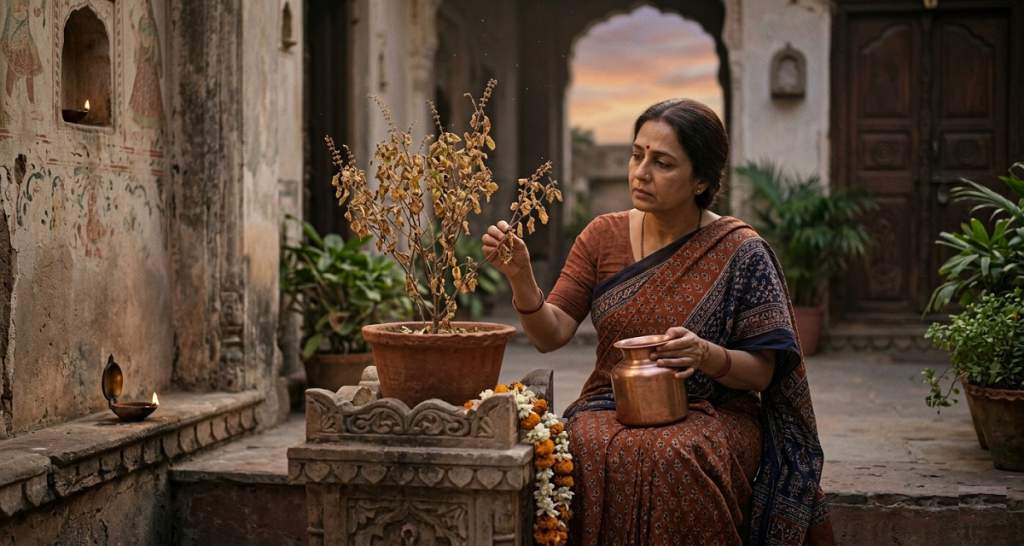
In many Indian households, the day doesn’t truly begin until the Tulsi (Holy Basil) plant has been watered and a small lamp—a diya—has been lit beside it. It isn’t just a plant; for millions, it is a member of the family, a symbol of purity, and a gateway to divine grace.
But what happens when this vibrant green symbol begins to fade? When, despite your best intentions, the leaves turn brown, the stem loses its life, and the plant begins to dry up?
Panic often sets in. We start wondering: Is something bad about to happen? Have I done something wrong? Is there negative energy in my house?
As an astrologer and someone who deeply values our ancient traditions, I have seen this concern many times. Today, let’s look at this situation not with fear, but with wisdom. We will explore why this happens, what it means spiritually, and how to look at it through the lens of both science and soul.
The Sacred Place of Tulsi in Our Lives
Before we discuss why it dries, we must understand why we value it so much. In our culture, Tulsi is regarded as an incarnation of Goddess Lakshmi. It is believed that where there is a healthy Tulsi, there is prosperity, health, and protection from the “evil eye.”
Scientifically, Tulsi is an incredible medicinal herb. It is an air purifier, a stress-buster, and an immunity booster. When we have a plant in our house that does so much for us, it is natural to feel a deep, personal connection with it. This is why when it dries, it feels like more than just a gardening failure—it feels like a missing heartbeat in the home.
The Spiritual Perspective: What the Elders Say
In traditional astrology and Vastu Shastra, plants are considered sensitive to the energy of a household. When a Tulsi plant dries, it is often interpreted as a “pre-emptive” warning. Here is how it is traditionally viewed:
1. Absorbing Negative Energy
One of the most common beliefs is that Tulsi acts as a spiritual filter. It is said that when negative energy, stress, or heavy vibrations accumulate in a home—perhaps due to constant arguments, jealousy, or financial strain—the Tulsi plant works overtime to neutralize it. In this process, the plant may sacrifice its own vitality to protect the family from that energy.
2. A Call for “Sattvik” Living
Sometimes, the drying of the plant is seen as a sign to bring more discipline into the home. If the household has moved away from positive habits, prayers, or peaceful living, the sudden decline of the plant is a wake-up call to refocus on spiritual practices and family harmony.
3. The Need for Respect
Neglect is not just physical; it is also about intention. If we treat our daily rituals as a “chore” rather than an act of devotion, the energy shifts. A drying plant is often a reminder to re-engage with our surroundings with love and mindfulness.
The Reality Check: Practical and Biological Reasons
While the spiritual side provides us with a sense of wonder and caution, we cannot ignore the physical reality. Tulsi is a living organism. It is sensitive to weather, water, and pests. Most of the time, the reasons are entirely scientific.
The Most Common “Killers” of Tulsi:
- Overwatering: Believe it or not, this is the #1 reason. Tulsi does not like “wet feet.” If the soil is always swampy, the roots begin to rot. A rotting root cannot take in nutrients, and the plant turns yellow and dry.
- The Seasonal Cycle: Tulsi is very sensitive to extreme temperatures. In the peak of Indian summers (the scorching heat of May and June) or the biting cold of December and January, the plant goes into survival mode. It is natural for it to shed some leaves or dry out a bit during these transition periods.
- Pests (The Unseen Enemy): Have you ever looked closely under the leaves? Mealybugs (those tiny white, cotton-like insects) are the biggest enemy of Tulsi. They suck the sap right out of the plant. If you don’t notice them, they will kill the plant within weeks.
- Lack of Sunlight: Tulsi is a sun-loving plant. If it is kept in a dark corner or in the shade for too long, it loses its strength and becomes prone to disease.
How to Balance Care and Faith
If your Tulsi plant is drying, don’t start worrying about bad luck. Instead, follow this “Spiritual & Practical” action plan to restore the balance in your home.
Step 1: The Inspection (Physical)
Look at the plant as if you are checking on a friend.
- Check the soil: Is it soggy? If yes, stop watering immediately. Let the top inch of soil dry out.
- Check for pests: If you see white spots or sticky webs, wash the leaves gently with a mixture of water and a few drops of neem oil.
- Sunlight: Move it to a spot where it gets at least 4–6 hours of morning sunlight.
Step 2: The Intention (Spiritual)
- Change your routine: If you haven’t been lighting a lamp regularly, start doing it again. It helps in grounding your own energy.
- Speak to it: It sounds simple, but plants respond to the environment around them. Spend a few minutes each day near the plant, maybe chanting a mantra or simply sitting in silence. Your calm state of mind will reflect in the health of your home environment.
Step 3: What if it is too late?
If the plant is truly gone, do not keep a dead plant in your house. It is considered inauspicious.
- Gently remove it from the pot.
- Offer it to a nearby river or place it under a large tree with respect.
- Clean the pot thoroughly, refresh the soil, and bring in a new, healthy sapling. This act of starting fresh is a wonderful way to renew the energy of your home.
Final Thoughts: Harmony is Key
At the end of the day, astrology and spirituality are meant to make our lives better, not to fill us with anxiety. If your Tulsi plant dries, treat it as a check-in.
Ask yourself:
- Am I taking care of my surroundings?
- Is my home peaceful?
- Am I stressed, and is that stress affecting how I look after things I value?
If you answer these questions with honesty and then apply some practical care to your plant, you will find that the “negative energy” you were worried about often disappears simply because you took control of your environment.
A home with a healthy, thriving Tulsi plant is a home that invites positivity. But remember, the most important part of that environment is you. Your care, your consistency, and your positive intention are what truly keep the “spirit” of the home alive.
Related – भूलकर भी न करें ये काम, वरना रूठ जाएंगी मां लक्ष्मी: घर में सुख-समृद्धि बनाए रखने के नियम