If you have ever walked down a bustling street in India, taken a ride in a local auto-rickshaw, or visited a brand-new shop on its opening day, you have almost certainly seen it.
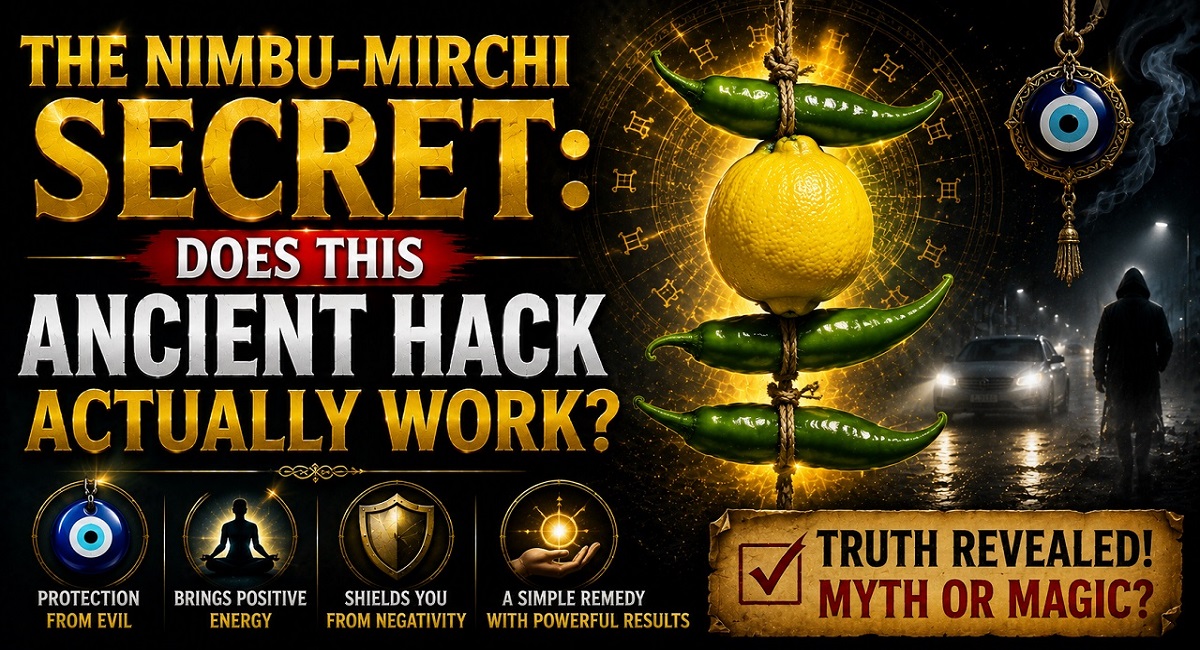
Hanging proudly over the doorway, dangling from the rearview mirror of a truck, or tied to the shutter of a small business is a simple string. On this string, you will usually find one bright yellow lemon and a few green chilies, pierced through by a cotton thread.
In India, we call it the “Nimbu-Mirchi” totka (remedy).
For generations, grandmothers have sworn by it. Truck drivers won’t start a long journey without it. Shopkeepers replace it religiously every week. The primary reason? To ward off Buri Nazar—the dreaded “evil eye.” It is believed to protect wealth, health, and prosperity from the jealous glares of others.
But let’s pause and think about it. Does tying a piece of citrus fruit and a few spicy peppers to a door frame actually do anything? Is it just blind superstition, or did our ancestors know something we have forgotten?
Today, we are going to dive deep into the fascinating world of the Nimbu-Mirchi. We will look at the ancient mythology, uncover the surprising scientific logic behind it, and finally answer the ultimate question: Does this ancient hack actually work?
The Mythology: A Tale of Two Sisters
To understand the Nimbu-Mirchi, we first have to understand where the idea came from. In Hindu mythology, the story revolves around two contrasting deities: Goddess Lakshmi and her older sister, Goddess Alakshmi.
Most people know Goddess Lakshmi. She is the beloved deity of wealth, prosperity, beauty, and good fortune. Everyone wants Lakshmi to enter their home. According to the legends, Lakshmi loves sweet-tasting things, light, and cleanliness.
But then there is her older sister, Alakshmi. Also known as Jyestha, Alakshmi is the exact opposite. She represents poverty, misfortune, sorrow, and bad luck. Wherever Alakshmi goes, trouble follows. And unlike her sister, Alakshmi has a very specific palate: she craves things that are sour, pungent, and spicy.
The Ultimate Decoy
The ancient logic goes like this: Alakshmi is always roaming the earth, looking for houses to enter and bring ruin to. If she arrives at your doorstep hungry, she will come inside your house to look for food. Once she is inside, your wealth and peace will leave.
So, what do you do? You hang her favorite food—sour lemon (Nimbu) and spicy chili (Mirchi)—right at the front door.
When Alakshmi comes to your house, she sees her favorite snacks hanging right there. She eats the lemon and chili at the door, satisfies her hunger, and leaves feeling perfectly content without ever needing to step foot inside your home.
It is, essentially, an ancient mythological decoy. You are feeding the goddess of bad luck at the gate so she doesn’t crash the party inside.
While this is a beautiful and deeply ingrained cultural story, it is just one piece of the puzzle. Our ancestors were incredibly observant people. Behind almost every ancient ritual, there is usually a very practical, survival-based logic.
The Science of Nimbu-Mirchi: A Natural Pesticide
Let’s step away from mythology for a moment and put on our science hats. To understand the practical use of Nimbu-Mirchi, we have to imagine life in India hundreds or thousands of years ago.
There were no concrete apartment buildings, no air conditioning, and no chemical insect repellents like we have today. People lived in homes made of mud, clay, and thatch. These natural materials kept the houses cool, but they also made them a prime target for insects, pests, and mosquitoes.
This is where the lemon and chili come into play as a brilliant, eco-friendly pest control system.
1. The Chemistry of Citrus and Spice
Lemons are packed with citric acid. Green chilies are loaded with a chemical compound called capsaicin (which is what makes them spicy) and zinc.
When you pierce a lemon and chilies with a needle and thread, you break their skin. This allows the juices from inside to slowly seep out.
2. The Role of the Cotton Thread
Notice that the Nimbu-Mirchi is always tied with a thick, natural cotton thread. You can’t use nylon or plastic wire. Why? Because cotton is highly absorbent.
The cotton thread acts like the wick of a candle. It absorbs the acidic lemon juice and the pungent chili juices. As the wind blows and the sun beats down on the string, the cotton thread helps evaporate these juices into the surrounding air.
3. The Invisible Shield
The evaporation creates a subtle but potent aroma around the doorway. To humans, it might just smell faintly fresh or unnoticeable. But to insects, mosquitoes, and small pests, the combination of highly acidic vapor and pungent capsaicin is incredibly irritating. It burns their senses and tells them to stay away.
By hanging this right at the entrance of a mud house, our ancestors created an invisible, natural, chemical-free barrier that kept disease-carrying bugs from flying inside.
So, does it work? From an entomological (bug-science) perspective, yes! It was a highly effective, cheap, and easily accessible DIY insect repellent for ancient homes.
The Ancient Traveler’s Survival Kit
The doorway wasn’t the only place you would find a Nimbu-Mirchi. In ancient times, traders, travelers, and farmers would often carry lemons and chilies with them when they traveled through dense forests and rural landscapes on foot or bullock carts.
Today, people hang it on their car bumpers and bike mirrors in the name of tradition. But back then, carrying these two items was a literal matter of life and death.
Here is why a lemon and a chili were the ultimate survival kit:
- The Snakebite Test: India has always been home to venomous snakes. If someone was walking through the tall grass and felt a sharp prick on their leg, panic would set in. Was it a thorn, or was it a deadly snake? To check, the traveler would immediately bite into a green chili. If the chili tasted incredibly spicy and burned their tongue, they were safe—it was probably just a thorn or a non-venomous bite. However, if they bit into the chili and tasted absolutely nothing, it meant their nervous system was shutting down and the venom was paralyzing their senses. They needed to find a local healer immediately.
- The Dehydration Cure: Walking miles in the blistering Indian sun leads to rapid dehydration, fatigue, and nausea. A lemon was a lifesaver. Sucking on a lemon or mixing its juice with stream water provided an instant dose of Vitamin C, electrolytes, and sugar to fight off heatstroke and sickness.
Over the centuries, the practical act of carrying a lemon and chili for safety during travel slowly morphed into the ritual of hanging it on vehicles to “protect” the journey. The intention remained the same—safe travels—but the method changed from practical survival to symbolic protection.
The Anatomy of the Perfect Nimbu-Mirchi
If you ask an elder in an Indian family, they will tell you that you cannot just throw any random number of lemons and chilies onto a string. There is a specific “recipe” to making a traditional Nimbu-Mirchi, and the numbers matter.
Here is the standard anatomy:
- One Lemon: It must be fresh, unblemished, and yellow or slightly green.
- Seven Green Chilies: Why exactly seven? In many ancient cultures, including Vedic traditions, the number seven holds immense significance (seven days of the week, seven chakras, seven colors of the rainbow).
- Black Coal (Sometimes): Often, a piece of black coal is tied at the very bottom. Coal is a highly porous material that absorbs moisture and odors from the air, further adding to the “purification” aspect of the charm.
- The Black Thread: While white cotton is used for the juices, the loop used to hang it is often black. Black is universally considered a color that absorbs negative energy.
- The Day of Hanging: It is strictly replaced on Saturdays (or sometimes Tuesdays). Saturday is the day associated with Lord Shani (Saturn) and, by extension, hardships. It is the day you want to be extra careful about warding off bad luck.
When the old Nimbu-Mirchi dries up and shrivels by the end of the week, it is believed to have absorbed all the negative energy and evil eyes cast upon the house or business. It is then thrown away—specifically, thrown onto a road where vehicles will crush it, completely destroying the negative energy. (Though today, throwing it in the dustbin is the much more hygienic and civic-minded approach!).
The Psychology of the ‘Evil Eye’
We have talked about mythology and we have talked about science. But to truly understand if the Nimbu-Mirchi “works,” we have to talk about human psychology.
Why do we care so much about Buri Nazar or the Evil Eye?
The concept of the evil eye is not exclusive to India. Almost every major ancient culture on earth has a variation of it:
- In Turkey, they have the Nazar Boncuğu (the blue glass eye).
- In the Middle East, they use the Hamsa (the hand amulet).
- In Italy, they use the Cornicello (a red horn charm).
The underlying belief is universal: Human envy has power.
When you buy a new car, build a beautiful home, or start a thriving business, you stand out. While your friends and family might be happy for you, human nature dictates that someone, somewhere, is looking at your success with jealousy. The belief is that this intense, negative, envious energy can physically manifest and cause you harm, accidents, or financial loss.
The Placebo of Protection
This is where the true power of the Nimbu-Mirchi lies today: Psychological peace of mind.
When a shopkeeper opens their store at 8:00 AM, sweeps the floor, lights an incense stick, and hangs a fresh Nimbu-Mirchi at the door, they are engaging in a powerful psychological ritual.
They are telling their brain: “I have done my part. I have secured my boundaries. I am protected from negativity.”
Does a lemon physically stop a bad business deal from happening? No. Does a chili prevent another driver from rear-ending your car? Obviously not.
But hanging that string gives the person a sense of confidence, safety, and focus. It reduces anxiety. When you feel protected, you perform better. You are less stressed. You interact with customers more positively. You drive with more focus.
In psychology, this is known as the Placebo Effect or a Psychological Anchor. If believing you are protected makes you act more confidently and calmly, then the charm is actually working—just not through magic, but through your own mindset.
Does Nimbu-Mirchi Still Make Sense Today?
Now we arrive at the big question. It is the 21st century. We live in concrete apartments on the 15th floor. We drive air-conditioned cars. We have pharmacies on every corner.
Do we really need to hang lemons and chilies anymore?
If we look at it strictly through the lens of logic and science: Not really.
- A lemon and chili string outside a modern, sealed apartment door is not doing much to keep bugs away. (A simple screen door and some mosquito repellent do a much better job).
- You don’t need a chili to test for snakebites when you are driving a Honda Civic to the office.
If we hold on to these rituals believing they are literal magic that will magically make us rich or immune to car crashes, we are leaning into blind superstition.
However, traditions are not just about raw logic; they are about identity and comfort.
There is something deeply beautiful about continuing a practice that your parents, grandparents, and ancestors did for centuries. The Nimbu-Mirchi is a thread that connects modern, fast-paced Indian life to its earthy, ancient roots.
When a young software engineer buys her first car and lets her mother tie a Nimbu-Mirchi to the bumper, she isn’t doing it because she thinks the lemon has magical force fields. She is doing it out of respect for her culture, out of love for her mother’s care, and for that warm, comforting feeling of starting a new journey with a positive blessing.
The Verdict: So, Does It Actually Work?
The answer is a resounding Yes, but it depends entirely on how you define “work.”
- Does it work as magic to stop bad luck? No. Life is unpredictable, and a fruit won’t change your destiny.
- Did it work as a scientific tool for our ancestors? Absolutely. It was a brilliant, observant use of natural chemistry for pest control and survival.
- Does it work today? Yes, as a powerful psychological tool. It acts as a mental shield, reducing anxiety, boosting confidence, and bringing a sense of cultural continuity and peace to our chaotic modern lives.
The Nimbu-Mirchi is the perfect example of how ancient traditions are formed. They start as highly practical, science-based solutions to everyday problems. Over centuries, as society changes and the original practical need disappears, the practice gets wrapped in the beautiful, mystical stories of mythology to ensure people keep doing it.
So, the next time you see that bright yellow lemon and those green chilies dancing in the wind outside a shop or on a truck, you don’t have to dismiss it as just a silly superstition. You can smile, knowing you are looking at a masterclass in ancient science, a clever mythological decoy, and a timeless symbol of the human desire to protect the things we love.
Related – Mercury Transit July 2026: Hidden Astrological Rules to Boost Your Income This Month